Our Movie(s)

In “The Four Agreements” and also “The Fifth Agreement”, Don Miguel Ruiz describes how we are all making our own movies. This metaphor has sparked a helpful understanding for me.

To summarize… you are the writer, director, producer, and star of your own movie. I play a role in your movie. Likewise, I am making my own movie in which I am the writer, director, producer, and star… and you play a major role in my movie.

When you and I interact, you will interpret any given situation through the lens that was created via your life experience. In observing the facts of what transpired, you might conclude that I am a big jerk. I, on the other hand, might conclude that my actions were thoughtful, loving, and kind.

I used to think there is only one truth… and that I have to argue for what I see as my version of that truth (I’m not a jerk!!). I love this idea of a movie because now I can accept that your movie can be different than mine. I might be creating an adventure movie while you are creating a drama. I don’t have to argue with you about your movie because I know it isn’t a shared movie that we are creating together. I don’t need to defend my honor and convince you that I shouldn’t be cast as that kind of character. There is no one single truth. There are only our perceptions of those facts that result in our own opinions that become our personal truth.

This doesn’t mean we should be callous towards the opinion they have about our movie. We need people to play major roles in our movie. If we disrespect their points of view, they could storm off the set of our movie production or refuse to play the role we were intending them to play. Conversely, if we listen carefully, they can teach us lessons we want to incorporate into our script. If we communicate well, perhaps we each can play the intended role that each of us desires for our own movie script.

This metaphor helps me accept others for their beliefs and opinions that might be different than mine. This includes political, religious, business, and relationship opinions. You are entitled to your opinion and perception. And I am entitled to mine. And we don’t have to reconcile them both. So now I can sit and listen calmly while you describe your movie. And I hope you then ask me about the movie I’m making.

This is a variation on the theme of my former post about “the old lady young lady” picture. We see the same facts and develop different opinions (truths) about those facts. And that’s ok.

Let’s apply this to politics. We can assume that “the other side” has its own reasons to make its movie. They are not wrong. We just don’t agree on what the truth should be. And we don’t have to agree because there is no single movie to agree on. There is no one truth – there is only our perception of the truth inside the movie were are making for ourselves. If we do everything we can to support our views, and society still votes to support the other side, then we must accept the setback and hope for change in the future. But to stay mad about the movie that others are making is only choosing to fill ourselves with toxicity that can impact our health and relationships.

Fear

Most of us adults are afraid, too. Fear is universal, it’s not just in you. You are not alone. Even your parents are afraid of things. We were afraid as children but the things we fear change over time. But always, there is fear. It’s actually a necessary feeling that we need in our lives. It can teach us to understand ourselves if we listen carefully.

It’s what you do with that fear that can determine the course of your life. Will you recognize it, yet not let it get in your way? Will you use it as an opportunity to learn? Will you let it prevent you from doing what you want to do, and being who you want to be? You are more powerful than you know. You have a choice. Don’t ignore it. Don’t be ashamed of it. Don’t run away from it. Try to figure out what it’s telling you.

Relationship Lessons, Part 1

In the essay below, keep in mind that the term “relationship” could be any human relationship, be it family, romantic, plutonic, or professional.

Taking Things Personally

In “The Four Agreements”, Don Ruiz Miguel tells us how dangerous it can be when we take things personally. He also tells us how important it is to “use our words impeccably”.

Forgiveness

In “The Book of Forgiving”, Desmond Tutu tells the story of how, when the cruel and racist system of apartheid in South Africa was abolished, the black leaders could have spent their efforts on retaliation towards their former oppressors. However, they knew this would only lead to generations of continued bloodshed. They instead implemented a process of “reconciliation” that began with forgiveness. They realized that forgiveness is not condoning the deeds of the past, but simply making a decision to not be upset about them anymore.

This process of forgiveness does not require the involvement of the person that is being forgiven… and herein lies the beauty… one can forgive another without the other even being aware. Forgiveness is not weakness; in fact, it takes great personal strength to avoid the negative emotions lurking nearby, ready to send us into war.

The process of forgiving can actually create additional strength in the forgiver as they take their own personal power back. They give themselves a gift no one can ever influence or take away from them. The forgiver has the ultimate power to be better, choose better, and release the negativity associated with resentment and contemptuousness. Without this burden, the forgiver can more easily allow joy to infiltrate their system.

Toxic Combo

This brings us to a toxic combination that can destroy relationships:

  • We take things personally, which makes us upset.
  • Then we don’t forgive, which makes us hold on to that anger.

As a result…

  • When we take things personally, and don’t forgive our perceived victimizers, we then tend to not use our words impeccably which only compounds the negativity.
  • When we don’t forgive, we then accumulate issues that pile up… one on top of another. We initiate a downward spiral that takes more withdrawals out of a relationship than the deposits that sustain it. Like our financial bank accounts, our emotional bank accounts cannot operate with a negative balance. As Stephen Covey taught us, we need more emotional deposits than withdrawals.

If we only practice one of the two solutions (don’t take personally, forgive), we could clear up a lot of issues. When we practice both, we cover a majority of the potential problems that destroy relationships and make it much easier to use our words impeccably.

Kind vs Nice

We should be clear that being “nice” is very different than being “kind”. Kindness is doing the best possible thing for everyone involved, even when the process is difficult and could appear unkind to others. Niceness is being careful not to upset anyone in the moment, even when the “right” thing to do might make some upset in the short term. Be kind, rather then nice. Nice is passive aggressive and avoids responsibility. Kind is brave and loving.

Self-Care

Forgiveness is a gift we give ourselves. In this way it is every bit as much about caring for ourselves than caring for the other person. As we take care of ourselves with forgiveness, it just so happens that we then also maximize the potential of our relationship with the other.

Forgive ourselves too

Forgiveness also applies to how we treat ourselves. Too often, many of us are our own worst critics. We feel like imposters who don’t deserve happiness because we seem to “fail” in the times we believe we shouldn’t*.

Our kindness can extend to one of the most important relationships of our lifetime… the one we maintain with ourselves! 

* This belief might be the root of this issue, but that’s a different post

New Tools

We now have tools to quickly get back on track if we notice something about ourselves that is less than ideal. Either:

  • Don’t take our failures personally and instead use them as teachable moments

OR, if that doesn’t work…

  •  We have a backup plan to forgive ourselves for falling short of our desired state of being.

Small or Large

This does not need to be reserved for large infractions of trust, such as a cheating spouse. This can and should occur throughout the microcosms of each day.

For example, as our children do something that initially starts to annoy us, we can avoid taking their words or actions personally… or if we do then we can immediately forgive them (and forgive ourselves for taking things personally)… to take away our initial negative response and send us down a new path of holding space to guide them towards what is best for their growth. We can release ourselves from our own parenting imperfections that might otherwise reverberate inside our bodies, taking up energy that could be used for more productive activities. We can maintain our own dignity.

When my kids leave my phone signed into their YouTube account, and without realizing I upload my own video to their account… I can quickly avoid frustration and retaliation when I forgive them immediately, without them even knowing. This more active approach feels better than the old “grit your teeth and try not to be irritated” method. This is a win for me because I turn a potential bad feeling into a good feeling of doing the right thing toward them.

Pressure is off

Once both people in a relationship embrace these tools, the pressure is off to be perfect because we don’t fear retaliation. We can be our true selves without having to

  • Carefully walk on eggshells
  • Put our words through a heavy-duty pre-processor that is mentally draining, which could ultimately lead to giving up on a relationship rather than taking the risk of upsetting someone.

Vulnerability is the key

When we take things personally and don’t forgive, we destroy the atmosphere that enables vulnerability to grow.

Brene Brown taught us that vulnerability is the fundamental source of the most wonderful aspects of relationships: empathy, creativity, belonging, joy, courage, and intimacy.

John Gottman taught us that safety is the foundation for vulnerability. A safe relationship can be tricky to maintain. These two new tools (don’t take things personally, forgive) can create safety… which leads to vulnerability… which leads to a great relationship.

No feeling is wrong

No feeling is ever “wrong”. Fear, anxiety, sadness, frustration, shame, disappointment, happiness, and pride… these feelings are merely teachers meant to send a message from our subconscious. However, the story behind the feeling that we tell ourselves – this can be wrong. We can now stop judging ourselves and those around us for our feelings. We all must be allowed to have our feelings. We can forgive ourselves immediately for having the story wrong that led to our feelings. We can listen to the feelings, and the story behind them, with curiosity rather than accumulating a new layer of additional negative feelings that speeds up the downward spiral and ruins vulnerability and intimacy. This curiosity is easiest to incubate in a safe environment… but when it doesn’t feel safe, we must summon courage that we might not have immediately available in every situation. We can forgive ourselves for that as well.

Confusion of Feelings

Keep in mind that an expression of a feeling is “I feel sad because…” or “I feel disappointed when…”. A feeling is not “I feel that you should do X in this circumstance”. We sometimes confuse feelings and belief systems.

Neutralize Criticism

John Gottman also taught us how the four horseman (criticism, contempt, defensiveness, and stonewalling) destroy relationships. Keep in mind that criticism can be perceived when it was never intended. We might feel bad when we perceive criticism (whether intended or not), and begin to make up a story in our own head about how unfair this perceived criticism is… leading to defensiveness. Our new tools can nip this in the bud by taking the charge out of criticism and avoid defensiveness. Whether it was intended or perceived… the person hearing the criticism can neutralize their response with our new tools… maximizing the chance for the renewal of the relationship and avoiding the accumulation of negativity and the resulting downward spiral.

Let’s say someone thought this post was terribly cheesy, even though many people loved it. The old “self-preservation Jason” would focus on the few people who were critical, just in case they were right and I should adjust to avoid criticism. Now I can immediately forgive myself in case this really is a terrible idea. I can stop to consider whether they have any points I can learn from. Then I can forgive them if it seems they are being unnecessarily critical. Or perhaps I just realize that their truth doesn’t match up to my own truth… and that’s ok. I won’t take it personally.

It’s ok to be not ok

Imagine Dragons sings “It’s ok to be not ok. It’s just fine to be out of our mind”. As this sank in during a live event, I was moved to tears. We can more easily forgive when we remember that it’s ok for all of us to make mistakes. It’s ok to get the story wrong that leads to feelings that might otherwise be considered “unnecessary”.

Lessons From Ted Lasso (spoiler alert!)

As everyone around Ted ridicules him by calling him names (“wanker!”) and undermines his attempts to do his job… he doesn’t simply ignore them. He hears them, and his response is “just wait until I win them over!”. When his boss does everything in her power to ruin the team’s chances of success, he immediately forgives her in the most sensitive and touching scene, recognizing the tough path of divorce she was walking. His empathy was made possibly because he didn’t take things personally, and practiced forgiveness.

Hanging onto the imperfections of others is living in the past. Demanding a better future is avoiding living in the current moment. These new tools are living in the moment.

The Obstacle is the Way

In “The Obstacle is the Way”, Ryan Holiday relays the message of the roman stoics who teach us that every difficult thing is an opportunity to be curious, learn, and grow. In order to stay curious so that we learn and grow, we must not take things personally and we must forgive.

100 Years From Now

I will be dead in 50 years. In 100 years, no one on this planet will be thinking of me. Why would we not forgive ourselves, and forgive those around us in order to maximize our precious days with these relationships we are so fortunate to have around us. This doesn’t mean we condone the past, it simply means we don’t live in it. It means we keep choosing to love every day.

Expect trouble

People will continue to disappoint us. Pretending that we will always be appropriate, considerate, and rational is a setup for disappointment and opens the door for the horseman to ride in. Our new tools can keep that door closed. Expecting trouble allows us to recognize it as it appears so we can say “hey I was expecting you, I thought you might arrive… I have some new tools to deal with you”.

It took me 50 years, and a divorce, to connect these dots. I’m just hoping to expedite your learning curve.

Jason

3.17.22

Written on the plane ride to see Marshmello in Houston with my kids, sister, and brother in law

Position vs Ego

Growing up with a father in the military, I was aware of military figures such as Colin Powell, who was a 4-star general, Chairman of the Joint Chiefs of Staff, National Security Advisor, and Secretary of State. One of his quotes that impacted me most, and significantly affected how I work with others, is:

Avoid Having Your Ego so Close to your Position that When Your Position Falls, Your Ego Goes With It!

This first assumption here is that, in a debate between two or more people, our position might fall! Often we debate with the assumption that we are right and our position will never fall – we just need the other person to understand more. So right away this is transformative… this acceptance that we might be proven wrong. We must even be on the lookout for it so we know when to make this shift and let our position fall. The only way to be on the lookout for this is to listen very carefully to what the other person is saying.

The second piece here is that when we debate, our egos are not at stake. The other person isn’t telling me that I personally am wrong – what they mean is that my position is wrong. This separation is freeing – that we can be wrong and not have it reflect who we are as a person. We can make big shifts on the fly and keep our integrity in tact. We can be proud that we are looking for truth rather than simply preserving ourselves.

Fighting” Hard

A debate could be seen as a military battle… we hold our position against our “opponent” until we realize that we are losing and then we retreat. In this case, retreating is agreeing that we were wrong and moving to a new position, which might or might not be the position our “opponent” was describing.

This military-style fighting analogy can work if the other person sees that you aren’t really fighting them as a person but rather only their position(s). It only works if they trust that you are listening to them and looking for the opportunity to change positions. They need to know you are willing to bend and adapt as new information is absorbed.

In a respectful debate, our opponent knows that we can be on opposite sides of an issue and not be adversaries or enemies… we simply see things differently based on the information (data) we have at the time. We are evaluating something outside and separate from ourselves. This means the other person is not against us personally… just against our position. This form of debate can actually be extremely fun and informative when the other person shares this perspective. However, it can be very difficult when they don’t understand and are tying together their position and ego. Be careful not to take this into any relationship without the other person fully appreciating your approach.

More quotes from Collin Powell

Dreams for my boys

I want them to…

Be kind and gentle with themselves and others 😻

Respect and forgive themselves and others ☮… even when they need 2nd chances 

Be inquisitive 🔎 and resourceful 🔧

Have healthy boundaries with others 🔒

Have relationships with all/any genders, orientations, and races 👦👧🌈 that are loving, safe, and vulnerable 💕😑

NOT be perfect. Perfection is a mirage and a trap 💣

Build healthy bodies 💪 that serve as the foundation for a lifetime of adventure 💃  

Find their own dreams 💭🏁🏆🎓 that lead them to other unexpected dreams🎶🎉🎯🎱 which lead to something they never saw coming 👀 and was the result of dedication, grit, and hopefulness 🔥

Be present 😁 in the moment, plan 📐 for the future🔮, think of the past as lessons learned 📖 rather than bad things 💀that shouldn’t happen

Let go of what you can’t control 🙏

Laugh as much as possible 🤣

Believe that they can be or do anything they set their mind to 💡👑💥

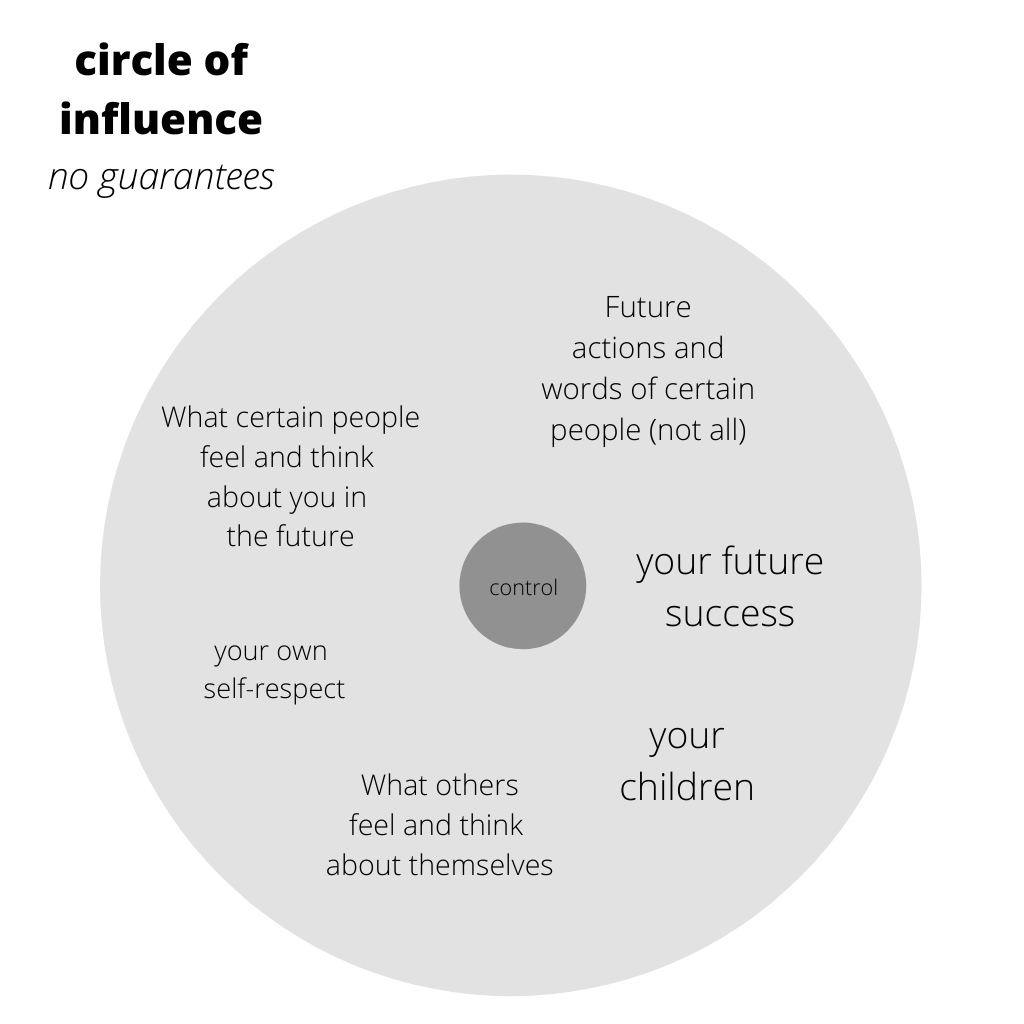
Circles of Concern, Influence, and Control

In “7 Habits of Highly Effective People”, Stephen Covey wrote about the Circles of Concern, Influence, and Control. This lesson can help us manage not only our time but our mental health and relationships. Trying to control the uncontrollable is not only a waste of time but results in negative emotions that can impact our effectiveness as parents, students, bosses, friends, and partners.

This is one of the hardest and most important lessons that I continue to re-learn. Though each time I get a little bit better at it.

Circle of Control: all the ways you can spend your time and energy in which you have complete control over the outcome. This is the most productive place to spend your time in the short run.

Circle of Influence: all the ways you can spend your time and energy in which you can merely influence the outcome rather than control it directly. This is the most productive place to spend your time in the long run. Influencing others in positive directions can change your life, and the lives of others, so much more than what you can achieve by yourself.

Note: you cannot expect specific outcomes. Take a deep breath when things don’t go your way. Let go.

Circle of Concern: all the areas of life outside the other two circles, in which you still care about the outcome. Putting energy, time, and effort into this area is dangerous! It’s a trap! Spending your time and energy in the other two circles will lead to less frustration, more fruitful outcomes, and better relationships.

Letting Go

Most of us care what others think and say about us. At some deep level, our psyche knows that our survival depends on both the feedback from others and the general reputation we have earned.

So when others have drawn the conclusion that we are different, or less than, how we see ourselves… we tend to want to correct their perception. We certainly do need to understand whether someone’s feedback and attitude is warranted and if so perhaps we need to change.

At the same time, and this is where life can be so difficult… we often need to ignore the perceptions that we believe (after much consideration) are inaccurate and are based on external factors we cannot control or influence. This is a difficult judgement call that might come across as narcissistic, self centered, callous, and mean to the other person.

This is “letting go” of the things we cannot control even when they unfairly cast us in a negative light. This is the acceptance that, while we prefer that others don’t have these perceptions of us, we must move on and focus our energy and time on being a better person for those who see and appreciate our gifts.

This requires us to simultaneously be considerate of the other person… while also being brave… even when our bravery appears to others as NOT being considerate. This is not an easy decision nor road to travel, but it might be your only choice to preserve your integrity and self-respect.

EXAMPLE: This can be very challenging when others make judgemental and condescending statements about our choices. For example, let’s say someone was mocking this blog… claiming it doesn’t represent their real-world experiences of me because that person doesn’t truly understand me. This could hurt deeply and perhaps make me less inclined to produce new blog posts… knowing that at least a few people out there are rolling their eyes and criticizing (even having fun at my expense). Letting go of their judgement is difficult. Making a new blog post takes bravery and courage in the face of that judgement. But their attitudes are beyond the circle of influence (or perhaps even outside of that!). We have to continue putting energy into the circles of influence and control.

Gottman

John Gottman is revered by many as a research-based relationship guru. I recently ran across five very insightful articles that do a great job of describing potential issues and fundamental needs in our primary relationships. They might even apply to some of our non-intimate relationships (friendships, colleagues, etc.).

The text below is copied directly from portions of the linked articles.

Solvable vs. Perpetual Problems

  • Solvable problems can be about housecleaning, disciplining children, sex, and in-laws. Solvable problems for one couple can be about the exact same topics that could be perpetual problems for a different couple. A solvable problem within a relationship is about something situational. The conflict is simply about that topic, and there may not be a deeper meaning behind the each partner’s position. A solution can be found and maintained.
  • Perpetual problems are problems that center on either fundamental differences in your personalities, or fundamental differences in your life style needs. All couples have perpetual problems. These issues can seemingly be about the exact same topics as what for another couple might be solvable; however, unlike a solvable problem, these are the problems that a couple will return to over and over and over again.
  • Gridlocked perpetual problems are perpetual problems that have been mishandled and have essentially calcified into something “uncomfortable.” When a couple tries to discuss a gridlocked issue, it can feel like they are “spinning their wheels” and getting nowhere. The nature of gridlock is that hidden agendas underlie the issue.

The goal should be to establish a dialogue about the perpetual problem that communicates acceptance of your partner with humor, affection, and even amusement, to actively cope with the unresolvable problem, rather than allowing it to fall into the condition of gridlock. Gridlocked discussions only lead to painful exchanges or icy silence, and almost always involve the four horsemen (criticism, contempt, stonewalling, and defensiveness).

Four Horsemen 

It’s important to understand these in more depth – I encourage you to read the article for details.

Recognizing Gridlock

  • The conflict leaves you feeling rejected by your partner.
  • No matter how much you talk about it, you feel thwarted. Despite your best attempts, you are making absolutely no headway in the problem area.
  • You become so impossibly entrenched in your positions that neither you nor your partner plan to budge.
  • Anytime the subject comes up, you invariably feel frustrated and hurt.
  • Your conversations about the problem are unpleasant as can be, entirely devoid of humor, amusement, or expressions of affection.
  • Your inability to budge increases with the passage of time, leading the two of you to vilify each other when this conflict arises.
  • In an infuriating catch-22, the reverse also manages to occur: as you vilify each other, your inability to budge and polarization in your views increases, and your chances of reaching a compromise plummet.
  • Upon traversing this delightful territory, the two of you end up in the land of total emotional disengagement.

Emotional Safety

The latest research in neurobiology shows that emotional safety is one of the most important aspects of a satisfying connection in a loving relationship. We need to feel safe before we’re able to be vulnerable, and as Brené Brown reminds us, “Vulnerability is the birthplace of love, belonging, joy, courage, empathy, accountability, and authenticity.”

When our body and mind experience safety, our social engagement system enables us to collaborate, listen, empathize, and connect, as well as be creative, innovative, and bold in our thinking and ideas. This has positive benefits for our relationships as well as our lives in general.

The Four Horsemen: The Antidotes

This is a great article with details on how to manage the four horsemen in any relationship.

Don’t say anything…

There’s an old phrase that I do NOT agree with:

If you can’t say anything nice, don’t say anything at all

Often there are hard things that need to be said that are not “nice”. Yes we need to be careful to say them as nicely as possible but certainly they will not be perceived as us being nice.

In looking for a phrase that guides us on what is appropriate to say… I like this one better.

Don’t say anything about someone that you wouldn’t say directly to them.

Or flipped around to the positive: “only say things about other people that you would be willing to say directly to them”.

I’m hard pressed to think of a time when this rule should ever be broken. We need to be able to have difficult conversations directly with the people involved. Talking to others about the situation might be fine* in order to get another’s perspective (or perhaps just to vent)… but the moment we say things that we are unwilling to divulge to the absent person… we are diving into toxic waters that poison relationships.

At 49 years old… I’m still working on this.

* so many factors can make this not fine. The type of information being shared, the relationship between the people you are talking to/about, whether the absent person would be upset if this other person knew the information, etc…. there’s a lot here and likely worth it’s own post.

Human Behavior

I have three goals for this blog: 1) if my kids ever read this, perhaps they will be provoked to consider new thoughts and maybe even learn a few things. At the least, they can get to know me better 2) in writing things down I might learn to see myself, others, and the world we live in differently 3) perhaps a few friends might be entertained.

One of the main themes I want to explore is the understanding of human behavior (both our own and that of others) in order to maximize our human relationships… which I believe is a key to happiness. We are social creatures who need good relationships in order to thrive.

But this is so, so messy. We are all so very hard to really understand.

For thousands of potential reasons, we behave in various ways at various times to various people. I’m not sure that even a PHD Psychologist after 30 years of therapeutic research has a wide and deep (and accurate) understanding of why we do and say the things we do and say. Understanding our behavior goes beyond just psychology but probably would need to include a thorough understanding of the impact of physiology, diet, exercise, pharmacology, sleep, DNA, income level, culture, spirituality, politics, life experiences – the list goes on. So many things can impact our mood, reactions, beliefs, brain patterns, etc. which all results in how we perceive and react to various situations.

However, it seems to me that understanding human behavior is a key to success in our relationships as well as careers… so how do we relatively quickly bridge this understanding gap? I have no idea. I certainly won’t get there in this lifetime. But I’m going to keep trying. Every little bit helps.

One thing we often do is take short cuts. We guess. We assume the intent of others. We make assumptions. And then we move on. We don’t have the time (or ability?) to really understand what led to the current situation. We can shift the direction of entire relationships based on assumptions that are built on top of previous assumptions. After this house of cards is stacked, we don’t question the bottom layer – we don’t want the house to fall down! If we previously didn’t have time to accurately figure out reality for a single layer… how would we have time now to investigate all these underlying truths?!

To be continued in a many part series…

You vs them

An objective of this blog is for us all (myself included) to enhance and maximize our human relationships. To do this, we need to find a way for us and others to feel good about, and get the most out of, our personal interactions.

In the 7 habits of Highly Effective People, Stephen Covey talks about the emotional bank account where we make deposits and withdrawals that lead to either a low balance (bad relationship) or high balance (solid relationship).

If you are consistently taking from and not giving to others, they might perceive your actions as self absorbed, narcissistic, or self centered withdrawals that can negatively impact our relationships. They might not be getting what they need from the relationship.

So, in an interaction between two people… is it taking (withdrawal) or giving (deposit) to dominate and control the agenda of any particular conversation? It could be either!

In a conversation with anyone, you shouldn’t assume that the other person wants to talk about themselves or their topics. What if that day (or every day!) they don’t want the spotlight and they actually prefer for you to tell them your stories, issues, plans, etc. You could be giving them a needed break and the enjoyment of hearing someone else’s perspective.

On the other hand, they might have a lot to say and prefer to have the spotlight on their agenda.

Emotional maturity includes developing a super power to determine whether your conversation should be a balanced mix of agendas or a focus on what one particular person needs at that time.

There is no right answer. The hard work of empathy is to figure this out without too many assumptions.